 Skip to content
 A door closer is a critical piece of door hardware designed to automatically close a door after it has been opened. While selecting the correct door closer model and power size is important, choosing the correct installation method is equally crucial. An unsuitable installation method can lead to poor closing performance, premature wear, safety risks, and even failure to meet fire or building code requirements.
In commercial, industrial, and public buildings, door closers are expected to perform reliably under high traffic conditions. The installation method directly affects:
• Closing force efficiency
• Door control and user safety
• Door and frame lifespan
• Aesthetic appearance
• Compliance with fire safety regulations
Many installation problems reported in the field are not caused by the door closer itself, but by incorrect mounting methods or improper installation positioning. For this reason, understanding the different door closer installation methods is essential for installers, contractors, architects, and hardware suppliers.
This article provides a complete and detailed explanation of the main door closer installation methods, including their working principles, advantages, limitations, and best application scenarios. By the end of this guide, you will be able to confidently select the correct installation method for almost any door condition.
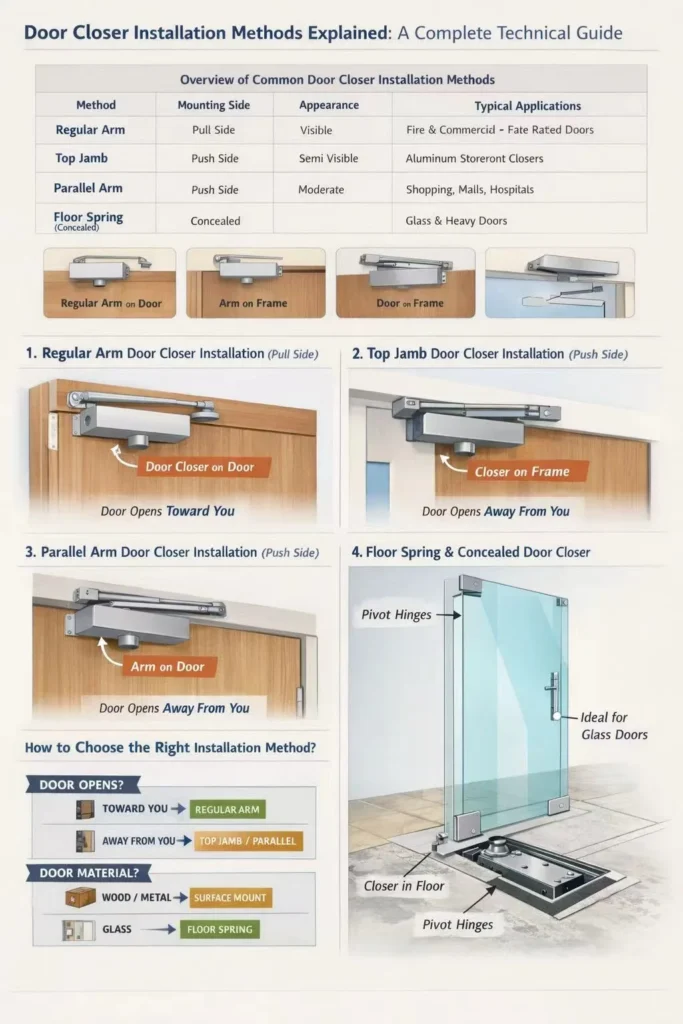
Overview of Common Door Closer Installation Methods
In the global door hardware industry, four installation methods are widely recognized and accepted:
1. Regular arm installation (pull side mount)
2. Top jamb installation (push side mount)
3. Parallel arm installation (push side mount)
4. Floor spring or concealed door closer installation
Each method has its own structural characteristics, visual appearance, and performance advantages. Most surface-mounted door closers are designed to support multiple installation methods using the same closer body, allowing flexibility during project planning.
Comparison of Installation Methods
| Installation Method | Mounting Side | Appearance | Closing Power | Typical Applications |
| Regular Arm | Pull side | Arm visible | Strongest | Fire doors, steel doors |
| Top Jamb | Push side | Semi-visible | Moderate | Aluminum frame doors |
| Parallel Arm | Push side | Clean & compact | Slightly reduced | Offices, schools |
| Floor Spring | Concealed | Invisible | Strong & stable | Glass doors, heavy doors |
Regular Arm Door Closer Installation (Pull Side Mount)
What Is Regular Arm Installation?
Regular arm installation, also known as pull side installation, is the most traditional and widely used method for surface-mounted door closers. In this configuration:
• The door closer body is mounted on the door leaf
• The closer arm and shoe are mounted on the door frame (header)
• The door opens toward the user
When the door is opened, the arm pulls the closer mechanism, storing energy in the spring. Once released, the spring power controls the door closing action.
Installation Position and Structure
In a regular arm installation:
• The closer body is usually positioned near the top hinge side of the door
• The arm is angled outward when the door is closed
• The arm becomes fully extended when the door is opened
This geometry allows the door closer to operate at maximum mechanical efficiency, making it the strongest installation method among surface-mounted options.
Advantages of Regular Arm Installation
- Maximum Closing Power
Because of the direct pulling action, regular arm installation provides the highest closing efficiency. This makes it ideal for heavy doors or doors with high air pressure resistance.
- Simple and Reliable Structure
The arm geometry is straightforward, reducing the risk of misalignment during installation.
- Ideal for Fire-Rated Doors
Fire doors require reliable and consistent closing force. Regular arm installation is commonly specified in fire-rated door assemblies. - Cost-Effective
No additional brackets or special accessories are usually required.
Disadvantages of Regular Arm Installation
- Visible Arm
The arm projects outward from the door, which may not be visually appealing in modern architectural designs. - Potential for Damage
In public areas, the exposed arm may be subject to vandalism or accidental impact.
Typical Applications
Regular arm installation is commonly used for:
• Steel doors
• Wooden fire doors
• Industrial doors
• Warehouse and factory entrances
• High-traffic commercial doors
It remains the default choice when strength and reliability are the primary concerns.
Top Jamb Door Closer Installation (Push Side Mount)
What Is Top Jamb Installation?
Top jamb installation is a push side mounting method, meaning the door opens away from the user. In this configuration:
• The door closer body is mounted on the door frame (top jamb)
• The arm and shoe are mounted on the door leaf
This method is often used when the door frame has sufficient depth but the door leaf has limited space for closer installation.
Installation Characteristics
Top jamb installation requires:
• Adequate frame depth to accommodate the closer body
• Accurate positioning to ensure proper arm geometry
• Precise drilling, as frame materials are often aluminum or steel
Because the closer body is mounted on the frame, the visible footprint on the door surface is reduced.
Advantages of Top Jamb Installation
- Cleaner Door Appearance
The door leaf remains relatively uncluttered, which is preferred in some architectural designs.
- Suitable for Narrow Door Top Rails
When the door top rail is too narrow to mount a closer body, top jamb installation becomes a practical solution. - Common for Storefront Systems
Aluminum and glass storefront doors frequently use this installation method.
Disadvantages of Top Jamb Installation
- Reduced Closing Efficiency
Compared to regular arm installation, the mechanical advantage is slightly reduced. - Frame Space Limitation
Not all frames provide sufficient depth for top jamb mounting. - More Demanding Installation Accuracy
Incorrect positioning can lead to poor door control or excessive arm stress.
Typical Applications
Top jamb installation is widely used for:
• Aluminum frame doors
• Commercial storefront doors
• Glass doors with metal frames
• Interior commercial doors with design restrictions
Parallel Arm Door Closer Installation (Push Side Mount)
What Is Parallel Arm Installation?
Parallel arm installation is also a push side mounting method, but with a key difference:
the arm is designed to fold back and sit parallel to the door surface when the door is closed.
In this setup:
• The closer body is mounted on the door
• A special parallel arm bracket is mounted on the frame
• The arm remains compact and low-profile
Why Parallel Arm Installation Is So Popular?
Parallel arm installation has become the most popular choice in modern commercial buildings due to its balance of performance, durability, and aesthetics.
Advantages of Parallel Arm Installation
- Clean and Modern Appearance
The arm is less noticeable, improving overall door aesthetics. - Reduced Risk of Vandalism
The compact arm position makes it harder to grab or damage. - Suitable for High-Traffic Areas
Schools, hospitals, and offices prefer parallel arm installations for safety and durability.
Disadvantages of Parallel Arm Installation
- Slightly Reduced Closing Power
The mechanical efficiency is lower than regular arm installation. - Requires Parallel Arm Bracket
Additional hardware may be required.
Typical Applications
Parallel arm installation is commonly used for:
• Office buildings
• Educational facilities
• Healthcare environments
• Public buildings
• Interior and exterior commercial doors
Floor Spring and Concealed Door Closer Installation
What Is a Floor Spring Door Closer?
A floor spring is a concealed door closing system installed below floor level. Unlike surface-mounted closers, the mechanism is hidden, leaving only the door pivots visible.
Installation Structure
Floor spring installation involves:
• Embedding the closer body into the floor
• Installing top and bottom pivots
• Precise alignment during construction or renovation
Because of the complexity, floor springs are typically installed during the early stages of a project.
Advantages of Floor Spring Installation
- Fully Concealed Design
Ideal for high-end architectural applications.
- Suitable for Heavy and Frameless Doors
Floor springs can handle very heavy doors with smooth control.
- Double-Action Capability
Many floor springs allow doors to open in both directions.
Disadvantages of Floor Spring Installation
- Complex Installation
Requires skilled installers and precise planning. - Higher Cost
Both product and installation costs are higher. - Maintenance Difficulty
Repairs may require floor access.
Typical Applications
Floor springs are commonly used for:
• Frameless glass doors
• Commercial entrances
• Shopping malls
• Hotels and office lobbies
How to Choose the Right Door Closer Installation Method
Choosing the correct installation method depends on several practical and technical factors.
- Door Opening Direction
• Door opens toward user → Regular arm
• Door opens away from user → Top jamb or parallel arm
2.
| Door Material | Recommended Installation |
| Steel door | Regular arm / Parallel arm |
| Wooden door | Regular arm / Parallel arm |
| Aluminum frame | Top jamb |
| Frameless glass | Floor spring |
3.Door Weight and Size
Heavier and wider doors require:
• Higher power closers
• More efficient installation methods (regular arm preferred)
4.Aesthetic Requirements
• Visible arm acceptable → Regular arm
• Clean design required → Parallel arm or concealed system
5.Fire and Building Code Requirements
Fire doors usually require:
• Reliable self-closing performance
• Approved installation methods
• Compliance with EN1154 or ANSI standards
Common Door Closer Installation Mistakes to Avoid
Even with the correct installation method, mistakes can reduce performance.
Frequent Errors Include:
• Incorrect handing selection
• Wrong mounting dimensions
• Ignoring frame depth limitations
• Using undersized closers
• Skipping final speed adjustment
Proper training and following manufacturer templates are essential.
Practical Installation Tips from Industry Experience
• Always verify door swing before installation
• Use the manufacturer’s drilling template
• Test door operation multiple times
• Adjust closing speed and latching speed carefully
• Recheck fixing screws after initial use
Frequently Asked Questions (FAQ)
Which door closer installation method is strongest?
Regular arm installation provides the highest closing efficiency.
Can one door closer support multiple installation methods?
Yes. Most surface-mounted door closers are designed for regular arm, top jamb, and parallel arm installations.
Is parallel arm suitable for fire doors?
Yes, provided the closer meets fire certification and is correctly installed.
Conclusion
Understanding door closer installation methods is essential for achieving reliable door control, long service life, and compliance with safety standards. Each installation method—regular arm, top jamb, parallel arm, and floor spring—has distinct advantages and application scenarios.
By carefully evaluating door conditions, usage requirements, and aesthetic expectations, professionals can select the most appropriate installation method and ensure optimal performance.
Correct installation is not only about fitting hardware—it is about safety, durability, and long-term reliability.
